Every invoice a verifiable record. Every client in one view.
A Veri*factu invoicing-integrity system for gestorías: each client’s invoices become hash-chained billing records, prepared for submission to the AEAT, with one dashboard across the firm’s clients.
VeriSovereign
Pilot
Pilot deployment, tested end to end against the AEAT pre-production service. The producer’s declaración responsable for version 1.0.0 is signed and published in the system; Veri*factu software is self-declared, so no AEAT approval is claimed. The public demo uses invented businesses and submits nothing to the AEAT.
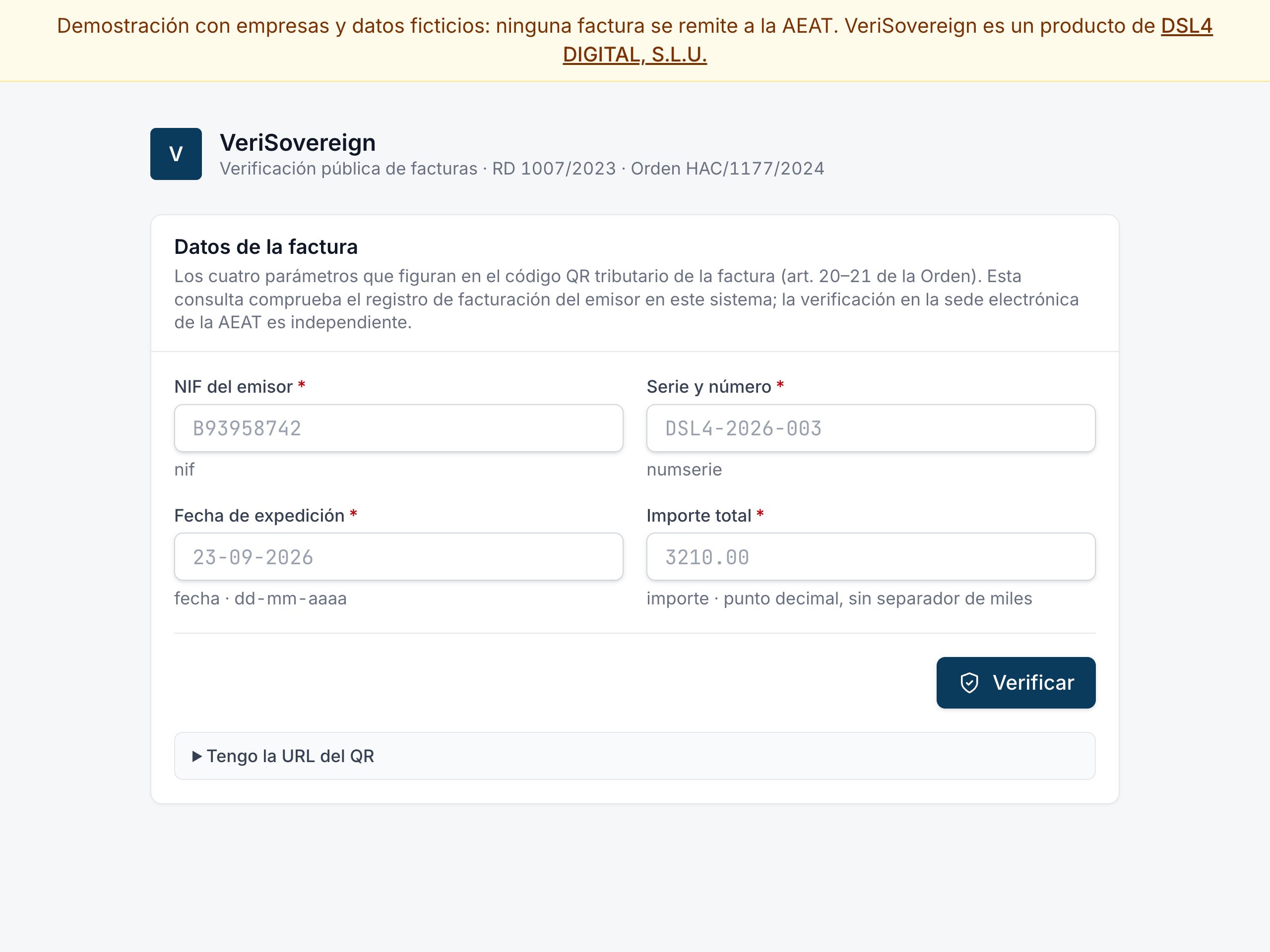
Expand the product preview for a full-size view.
THE PRODUCT
What it solves.
Spain’s Veri*factu regime (Real Decreto 1007/2023 and Orden HAC/1177/2024) asks invoicing software to produce chained, verifiable billing records. A gestoría carries that obligation for many clients at once. VeriSovereign is a headless, white-label system built for that position: one place to record invoices for many clients, see which ones need attention and export a per-client dossier.
A FastAPI and Celery backend on PostgreSQL turns each invoice into a SHA-256 hash-chained RegistroAlta or RegistroAnulacion, validated against the AEAT’s published XSDs and checked against its official hash test vectors. A deterministic tax engine covers IVA, IGIC and IPSI. A SOAP client implements the AEAT’s flow-control rules and has been exercised against a simulated AEAT endpoint. Records, QR-coded PDFs and AEAT responses go to write-once object storage on EU infrastructure, and a nightly sweep re-verifies each chain. A Next.js dashboard gives gestorías a multi-client view. It operates in VERI*FACTU mode only.
Hash-chained recordsAEAT XML / SOAPWrite-once storageMulti-client dashboard
WHO IT IS FOR
Who it’s for.
VeriSovereign is for gestorías and asesorías that handle invoicing for many client businesses, and for billing or ERP software that needs a Veri*factu back end without building one. It was designed with Canary Islands firms in mind, where IGIC is easy to get wrong, and for anyone who must quickly show an inspector what was recorded and sent.
FEATURES
What it does.
Checked before it is chained
Each invoice is first tested against every locally checkable rule in the AEAT’s «Validaciones y errores» specification. Problems come back as structured errors carrying the AEAT error code, before anything enters the chain.
Rejections and corrections
A rejected record keeps its AEAT error code and can be corrected with a subsanación. Duplicates are never re-sent; after a failed envío, pending records go again oldest first, flagged as an incident.
Ready for an inspection
A client’s records for a period export as one archive, and the export is logged as an event. A compliance dossier PDF sets out chain integrity, anomalies, daily anchors, events and submission results.
Filing only with a legal basis
A certificate sends an issuer’s records only if it is the issuer’s own, or if a recorded colaboración social or apoderamiento names its holder as representative. A certificate with no identifiable holder never acts for anyone.
AVAILABILITY
Status, pricing and access.
VeriSovereign is in pilot and has no public pricing yet. It has been exercised end to end with DSL4’s own invoice cases against the AEAT pre-production service, and the public demo, populated with invented businesses, shows the multi-client dashboard.
FAQ
Common questions.
Does it handle Canary Islands invoices?
Yes. A Canary issuer’s timestamps use Canary time. Services billed to a Península business are recorded as not subject to IGIC (N2, ClaveRegimen 08), with the customer self-assessing IVA. That case and standard 7% IGIC were accepted by the AEAT pre-production service.
Does an accepted record mean the software is certified?
No. A «Correcto» answer confirms that record’s XML and chain; the AEAT states that acceptance is not a certification of the invoicing system. Producers self-declare conformity in a declaración responsable (RD 1007/2023 art. 13; Orden HAC/1177/2024 art. 15).