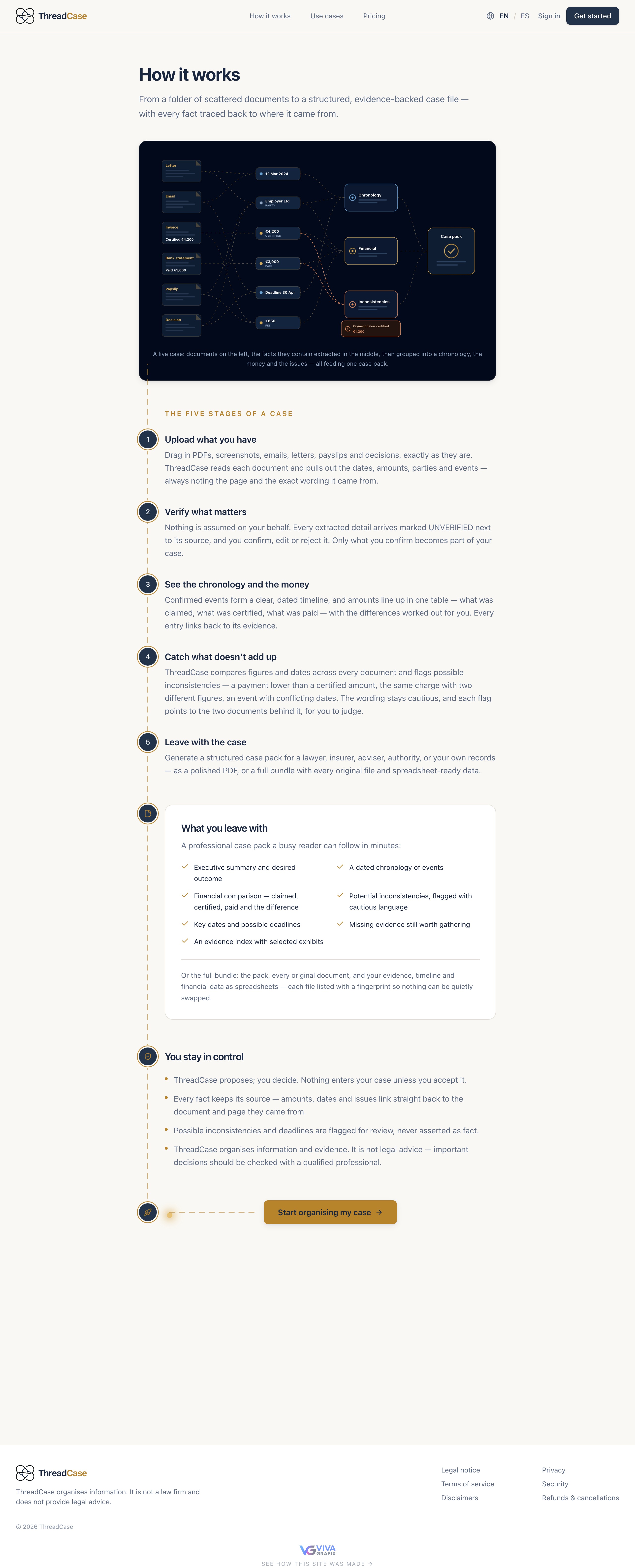
A personal dispute and evidence organiser: upload letters, emails, screenshots and payslips, confirm the facts it finds, and leave with a chronology, a money table, deadlines and a case-pack PDF.
ThreadCase
Beta · Now available
Public beta: sign up and build a case at threadcase.dsl4.com. Free tier available; paid case packs and plans are listed on the site.
Expand the product preview for a full-size view.
THE PRODUCT
What it solves.
People handling a dispute themselves often have the evidence but not the order: dates in one letter, amounts in a payslip, a deadline buried in a decision. ThreadCase turns those documents into a structured case that can be handed to a lawyer, insurer, adviser or authority. It organises information; it is not a law firm and does not give legal advice.
ThreadCase is a Next.js application on PostgreSQL, where row-level security policies enforce workspace isolation inside the database and integration tests check that cross-workspace reads and writes are rejected. Each upload moves through a database-backed pipeline: validation, text reading with OCR, extraction and fact proposals. Paid plans use OpenAI for extraction; a deterministic rule-based extractor serves the free plan and takes over automatically if the AI call fails. Case packs are rendered as PDFs with bookmarks, contents and page numbers.
Verification-first factsRow-level securitySHA-256 fingerprintsEnglish and Spanish
WHO IT IS FOR
Who it’s for.
ThreadCase is for people handling a dispute themselves, such as unpaid wages, a dental or medical complaint, an insurance claim, a debt or an administrative appeal, whose evidence is spread across letters, emails, screenshots and payslips. It helps them hand a clear file to a lawyer, insurer, adviser or authority. It organises information; it is not a law firm and does not give legal advice.
FEATURES
What it does.
Facts you confirm
Dates, amounts, parties and events found in each upload arrive as unverified proposals showing the source document, page, text excerpt and a confidence score. Nothing reaches the timeline, money table or deadlines until you accept it.
Inconsistency flags
A rule-based engine compares facts across documents and flags conflicting amounts and, on Case Pro and Vault, conflicting dates and payments lower than a certified amount. Each flag uses cautious wording and points to the documents behind it.
Exports and review links
The full bundle adds every original file, a CSV evidence index listing each file’s SHA-256 fingerprint, and timeline and money data as spreadsheets. Redactions are burned into exhibit images. Review links expire within 365 days and can require a password.
CLOUDFLARE & PRODUCT ARCHITECTURE
Inside the system.
Proposals, not conclusions
Every extracted date, amount or party is stored as a proposal with its source document, page and excerpt. Only facts the user accepts reach the timeline, money table or deadline tracker, and accepted deadlines are still marked as needing verification.
Isolation enforced by the database
User-scoped operations run under a restricted Postgres role that carries the user’s id, and row-level security policies decide what each workspace can read or write. Uploaded files sit in private storage behind signed, expiring URLs.
Work that survives failures
Uploads and exports only enqueue jobs. A poller claims each job atomically, recovers jobs left behind by a stopped worker and keeps failures visible and retryable, so a crashed request or an AI outage does not lose an upload.
AVAILABILITY
Status, pricing and access.
The free plan covers one active case with rule-based extraction and a watermarked one-page preview. Case Pack (€19, 30 days of access) and Case Pro (€49, 90 days) are one-off payments for a single case; Vault (€7.99 a month) keeps up to five active cases. Prices include tax. Paid plans add AI-assisted extraction.
FAQ
Common questions.
Is my evidence used to train AI?
No. On paid plans, document content is sent to OpenAI only to extract facts and is not used to train models; the free plan uses a rule-based extractor. Files are stored privately in Cloudflare R2 and case data in an EU-hosted Supabase database.
Can I delete everything?
Yes. Account, then Privacy & data, lets you download a machine-readable archive of your account, cases and evidence, or delete the account. After a deletion request, account data, case data and uploaded files are permanently deleted within 30 days.