Paste references in any common layout
Paste one reference or a whole list: numbered ([1] or 1.), one per line, or separated by blank lines. DOIs, arXiv IDs and PubMed IDs are detected automatically; BibTeX and RIS files are not parsed yet.
 Platform / Sign in ↗ES
Citation verification for researchers and AI agents. RefExists checks scholarly records, matches titles and authors, and explains the evidence behind each result.
DSL4-developed open-source tool. Verification establishes whether a reference exists and matches, not whether it supports a claim.
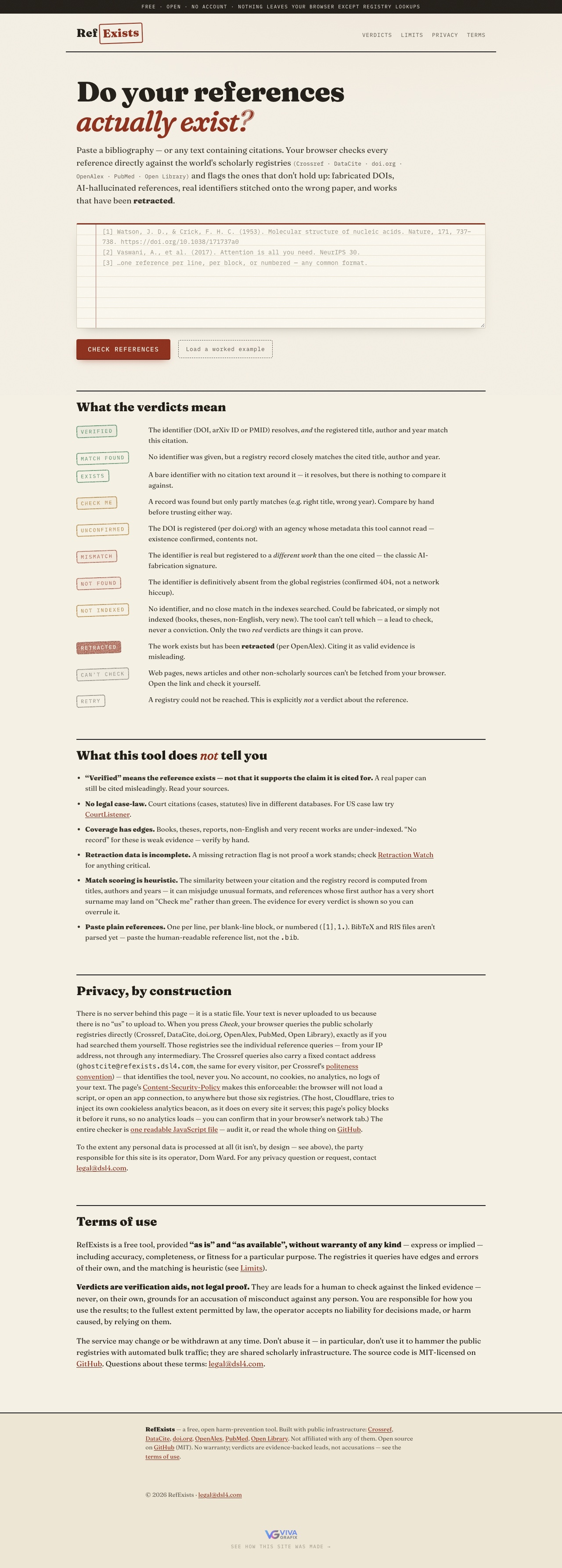
A plausible citation can still contain a fabricated identifier, mismatched authors or a retracted paper. RefExists turns a bibliography into inspectable registry checks, helping people review sources and agents check references before returning them.
The same JavaScript verification engine runs in the browser and through a local, keyless Model Context Protocol (MCP) server. It queries Crossref, DataCite, DOI infrastructure, OpenAlex, PubMed and Open Library, preserving the difference between a failed network request and a missing record. Individual lookups go to the registries; the bibliography is not uploaded to a DSL4 backend.
RefExists is for anyone who has to stand behind a reference list: researchers checking a draft, people reviewing unpublished manuscripts or misconduct cases, and anyone holding documents that should not be uploaded to a third-party checker. Developers of AI agents can use the same engine to check citations before answering.
Paste one reference or a whole list: numbered ([1] or 1.), one per line, or separated by blank lines. DOIs, arXiv IDs and PubMed IDs are detected automatically; BibTeX and RIS files are not parsed yet.
Each reference gets a labelled verdict, from Verified and Match found to Check me, Mismatch, Not found, Not indexed and Retracted. Only Mismatch and Not found are treated as proof; the others prompt a human check.
When a DOI resolves, RefExists asks OpenAlex whether the work is marked as retracted and shows a banner if it is. A missing flag is not proof a paper stands, so critical sources still deserve a Retraction Watch check.
An assets-only Cloudflare Worker serves the application. The verification work runs on the user’s device, so serving the interface does not require a hosted inference or bibliography-processing backend.
Identifier resolution and metadata matching expose the underlying registry evidence. Network failures remain inconclusive; a missing record is a reason to investigate, not proof of fabrication.
The local MCP server exposes verify_citations using the shared engine. This makes verification reusable in agent workflows without creating a second, divergent implementation.
RefExists is free to use at refexists.dsl4.com, with no account, no cookies and no usage cap beyond the registries’ own public rate limits. The source code is MIT-licensed on GitHub; the MCP server runs locally on Node 18 or later and needs no API key.